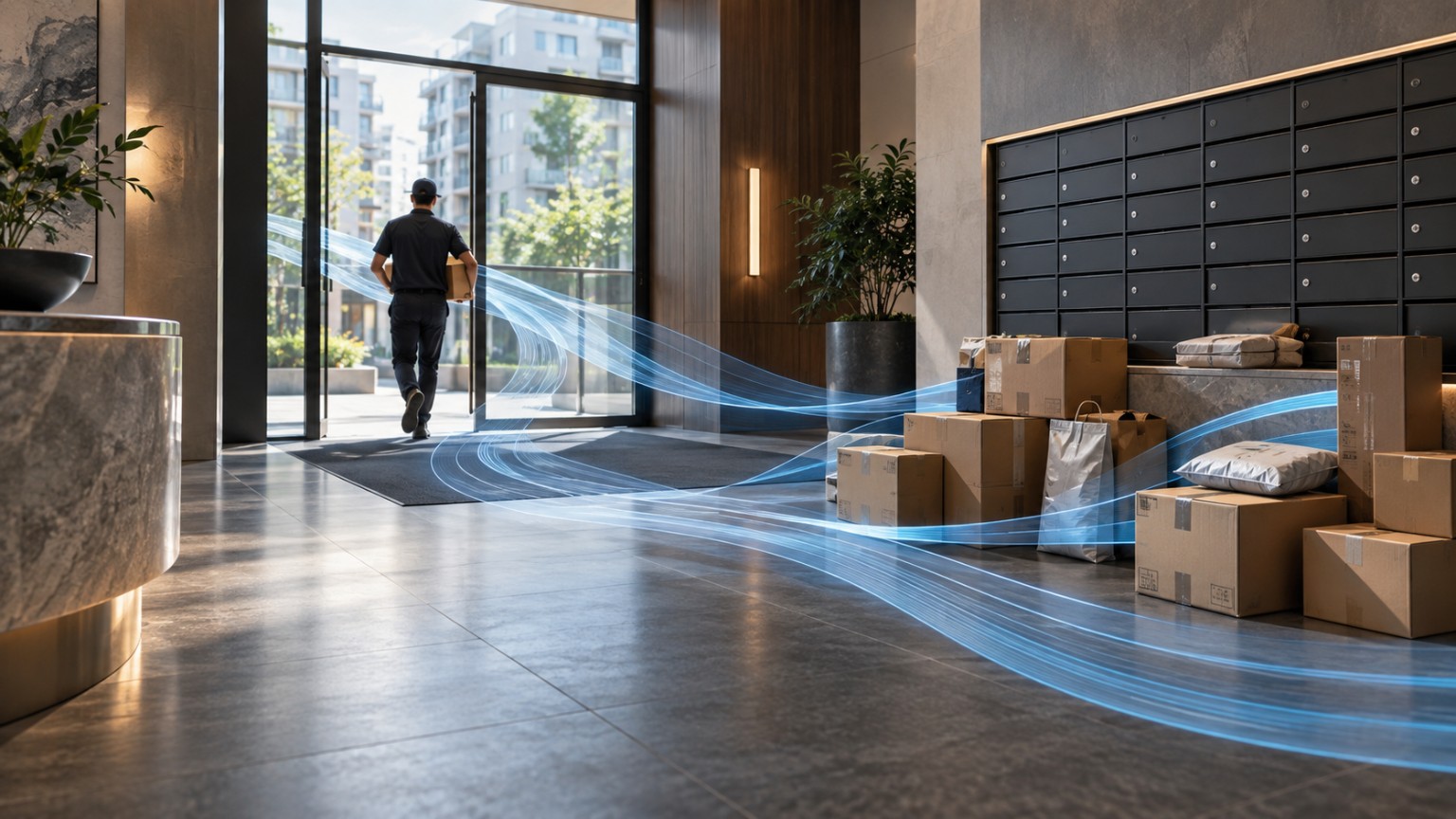
I was having a conversation recently in Pyrmont about parcels being left on common property.
The neighbouring building had taken a fairly hard position.
They didn’t want parcels left on common property at all.
And you can understand why.
Parcels create clutter. They get stolen. They can create trip hazards and other operational problems. Residents complain. Building management gets dragged into something that, in many cases, isn’t even specifically included in their service agreement.
So the obvious question came up.
Why can’t residents just get their parcels sent to the Post Office?
Or a parcel locker.
Or a parcel hub.
Or somewhere else secure.
And my answer was basically:
That would be fantastic.
In a perfect world, I suspect a lot of delivery businesses would love that too.
Imagine being able to consolidate hundreds of individual residential deliveries into secure, predictable locations.
Fewer missed deliveries. Fewer parcels exposed to theft. Fewer replacements. Fewer exceptions. Cleaner delivery routes.
If the customer said, “Send my parcel to the parcel hub,” life gets considerably simpler.
A fair chunk of the problem I work on probably wouldn’t exist.
But that isn’t the reality we live in.
That isn’t what the customer asked for.
They asked for home delivery.
Quite often, they have specifically given authority to leave the parcel because they want it waiting for them when they get home.
Residents have overwhelmingly voted with their feet for convenience.
We’re already past debating whether that behaviour exists. Buildings are dealing with the consequences of it every day. Some have introduced policies around parcels. Some have gone as far as passing by-laws intended to stop parcels being left on common property.
The more interesting question is why the behaviour persists.
And once you look at the incentives, it isn’t particularly mysterious.
The resident wants convenience.
The retailer wants to make the sale and satisfy the customer.
The carrier is part of the commercial chain fulfilling that delivery request.
Then the building steps in and says:
Don’t complete the delivery the way the customer asked. Send it somewhere else.
The building’s position may be completely reasonable.
But the incentive flow is only heading in one direction.
“Send it somewhere else” sounds like a delivery instruction.
In practice, it is a consumer behaviour strategy.
Because if you want the parcel to go somewhere else, the resident has to start choosing somewhere else.
And that isn’t a one-off education exercise.
Residents move in and out.
Existing residents start buying from new retailers.
Different retailers offer different delivery options.
Some make collection points easy. Some don’t.
Carriers change. Processes change. New residents arrive and need to learn the building’s preferred system. Existing residents need reminding.
So building management can replace one ongoing operational problem, managing parcels, with another ongoing operational problem, managing resident behaviour.
And when that behaviour change isn’t complete, they can end up doing both.
Which leaves an uncomfortable question.
What do you do when the outcome you want requires you to continually fight behaviour that almost every other incentive in the system is reinforcing?
It reminds me of getting caught in a rip at the beach.
The instinctive reaction makes perfect sense.
The beach is right there.
That’s where you want to go.
So you swim directly towards it.
The current pushes you backwards, so you swim harder.
You’re a decent swimmer. You know exactly where you want to get to. Surely more effort gets you there.
Except that’s the problem.
You’re trying to overpower the environment instead of responding to it.
Surf Life Saving NSW teaches people caught in a rip to attract attention, conserve energy and, where appropriate, move parallel to the beach towards the breaking waves rather than continuing to fight directly against the current.
The problem isn’t necessarily your ability to swim.
It’s the strategy.
Businesses do versions of this all the time.
Think about Apple.
When Steve Jobs returned to Apple, the personal computer market was dominated by Windows PCs.
Apple could have framed its entire challenge as:
How do we convince more Windows users to abandon their PCs and buy Macs?
It kept making better Macs.
But it also started looking at what consumers were already doing with technology.
Digital music. Photos. Video.
Apple began talking about the Mac as a “digital hub” at the centre of those activities.
Then came the iPod.
And this is the part I find interesting.
The original iPod was tied to the Mac.
But in 2002 Apple brought the iPod to Windows users. In 2003 it launched iTunes for Windows.
Apple didn’t insist that the enormous Windows market change first before it could serve them.
It went to where those customers already were.
You could own a Windows PC and still buy an Apple product.
You could experience Apple without first making the much bigger decision to replace your computer.
And it worked.
By 2005 Apple had sold 22.5 million iPods in that year alone, while Mac unit sales grew 38%. More importantly for this argument, Apple itself said it believed the success of the iPod was positively affecting Mac sales by introducing new customers to its other products.
Apple didn’t stop wanting people to buy Macs.
It found another route to them.
There’s a version of the same strategic question playing out right now with AI.
You can love it, hate it, distrust it, think parts of it are overhyped or think it will change everything.
But those opinions are separate from the operating question.
If the capability continues to develop and people continue finding useful ways to apply it, businesses have a choice.
They can spend their energy trying to preserve the old operating model.
Or they can work out where the genuine leverage is, what still requires human judgement, what becomes easier, what becomes cheaper, what becomes possible, and how their business should change around that reality.
Adaptation doesn’t mean blindly embracing every new thing.
It means recognising when the environment has changed enough that insisting on the old route has become the greater risk.
Apple still wanted customers inside its ecosystem.
It just stopped insisting that everyone take the most direct route to get there.
The safe strategy isn’t necessarily to abandon the destination.
You still want to get back to shore.
You just stop trying to reach it by fighting directly against a current that is stronger than you are.
You work your way across it.
The current may still carry you while you move, but eventually you get beyond the part that is pushing directly against where you want to go.
Then you can head back in.
The destination didn’t change.
The route did.
And that is where I think apartment parcel management is today.
Building management still wants the same destination.
Safe buildings.
Clear common areas.
Less theft.
Fewer complaints.
Less operational burden.
Nobody is suggesting those outcomes should be abandoned.
The question is whether continually telling residents to send their parcels somewhere else is still a realistic route to achieving them.
Because home delivery isn’t an emerging behaviour we might be able to head off before it catches on.
The ship has sailed.
Consumers value convenience.
Retailers sell convenience.
Delivery businesses fulfil that demand.
And apartment buildings are where those systems eventually meet physical reality.
A building manager can take the hard line that parcels aren’t part of their job.
They may even be technically correct.
Look through many building-management service agreements and accepting, sorting or managing residents’ parcels may be nowhere in the scope.
But saying “not our job” doesn’t remove the operational consequences.
The parcels can still arrive.
They can still create clutter.
They can still create safety issues.
They can still be stolen.
Residents can still complain.
And continually telling residents that their parcel problem isn’t management’s problem probably isn’t a brilliant long-term client-retention strategy either.
That doesn’t mean building managers should become unpaid concierge services.
It means the environment around their job has changed.
And good operators adapt to the environment they actually operate in.
That may mean better access.
It may mean a parcel room.
It may mean lockers.
It may mean better building design.
It may mean a combination of technologies and processes.
Different buildings will need different answers.
The mistake is choosing the answer before recognising the behaviour the system has to accommodate.
If residents continue to choose home delivery, the useful question isn’t:
How do we make them stop wanting it?
It is:
How do we make the behaviour they have already chosen produce a better outcome for everybody involved?
For the resident who wants convenience.
For the carrier trying to complete the delivery efficiently.
And for the building that has to live with what happens after the van drives away.
That’s not surrendering to the current.
It’s recognising which way the water is moving and designing a better route through it.
Because when the market has already shifted, swimming harder in the opposite direction isn’t necessarily persistence.
Sometimes it’s just a poor strategy.
What have I missed?
Use your name and email. Your email stays private. Comments are moderated before publication.