
I take photos of maps at apartment complexes everywhere I go.
Not because I’ve developed a strange fascination with apartment wayfinding.
They help me understand how the site actually works. How many buildings are there? Which entrances matter? Which lobby serves which apartments? Where are parcels supposed to end up? How is a driver expected to move through the property?
And some of them are bloody complicated.
I’ve had building managers tell me it took them a couple of weeks to properly figure out their own complex.
They work there.
Now imagine seeing it for the first time with a van full of parcels and a clock running.
Different towers. Different lobbies. Different street addresses. Basement entries. Rear access. Then add parking.
Sometimes there’s nowhere useful to stop near the entrance you need. The driver either double parks and tries to get in and out quickly, or parks further away and starts lugging parcels across the site before they’ve even worked out where those parcels belong.
It’s easy to see a pile of parcels dumped in the wrong lobby and think:
Bloody delivery drivers.
And sometimes you’d be absolutely right.
But that’s not the whole problem.
Sometimes the driver really does take the piss
I’ve worked on the delivery side of this too.
I’ve seen drivers knowingly take shortcuts because the shortcut was easier. I’ve watched the reaction when they discovered their route contained apartments. I’ve seen people drag their feet and later ask dispatch for help. I’ve heard drivers openly talk about leaving parcels somewhere convenient because getting them to the correct location took too long.
So this isn’t an apology piece.
Training, clear instructions and accountability all matter. If someone continually refuses to do the job properly, maybe they shouldn’t be doing it.
But if we want to solve the problem rather than simply find someone to blame, we also need to understand why the shortcut is attractive.
Finishing early has value
There’s a misconception I hear reasonably often that drivers are paid per parcel and therefore rush because they aren’t being paid properly for the time involved.
That wasn’t the model I worked with.
The DSP drivers I worked with were a mix of full time, part time and casual employees, rostered on for set shifts. Routes were designed around those shifts. Finish early and, in practical terms, you got your time back.
Flex works differently, but the incentive points in the same direction. A driver accepts a block with payment attached to it. Finish sooner and the payment doesn’t shrink because the driver was efficient.
Plenty of the drivers I worked around also moved between different forms of gig work. Finish Amazon three hours early and those can be three hours driving Uber, delivering food or earning money somewhere else.
So finishing early can have real value.
A straightforward suburban route can reward efficiency beautifully.
Apartments can destroy that efficiency just as beautifully.
One stop can suddenly involve parking, carrying ten parcels, locating the right building, finding the right lobby and then discovering there’s a locked door between you and where those parcels belong.
Explaining the incentive isn’t excusing the behaviour.
But pretending the incentive doesn’t exist won’t help us change it.
The technology does a lot of the thinking. Until the last inch.
App based delivery work removes a lot of complexity.
GPS gets the driver to the address. The app sequences the stops, identifies the parcel and tells the driver what comes next.
That allows people with different levels of experience, local knowledge and communication ability to become productive quickly.
Then they reach a complicated apartment complex.
The technology gets them to the street address and, comparatively speaking, says:
Good luck from here.
Then the physical environment hands the complexity straight back.
Which building? Which lobby? Where can I park? Which entrance? Can I get through the door? Where is the parcel actually meant to go?
So give them better maps?
Absolutely.
Maps help. Signage helps. Clear building names and delivery instructions help.
But they only solve part of the problem.
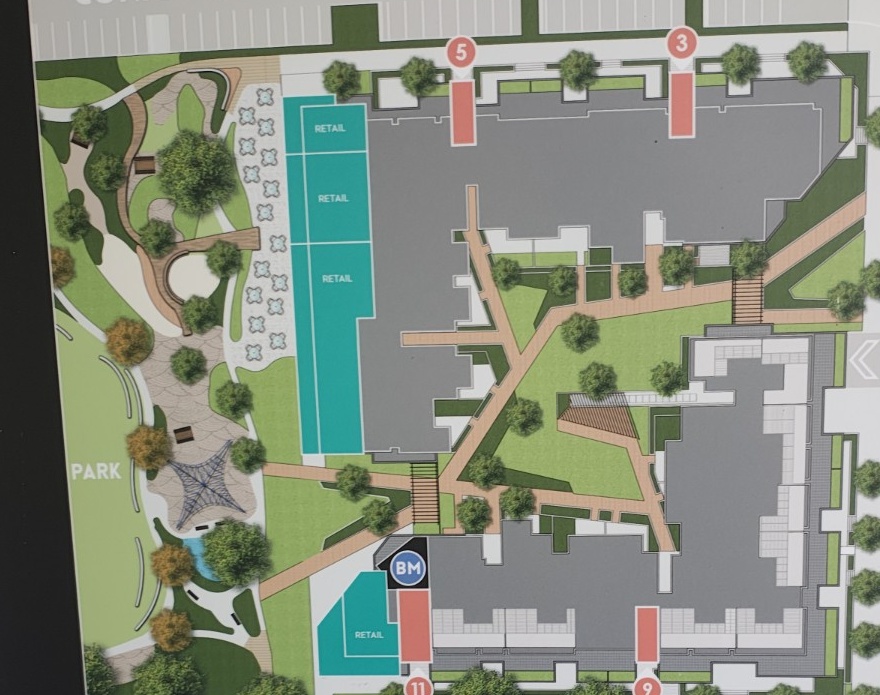
A map can tell you where the right lobby is. It can’t open the door.
Knowing where a parcel belongs and being able to put it there are two different problems.
Which normally brings us to the next suggestion.
“Just buzz the resident.”
Sounds reasonable.
Let’s assume the driver does everything right.
They find the correct building and entrance. They have ten parcels for ten residents behind the same locked door.
Say each intercom attempt takes thirty seconds to ring out.
Ten apartments later, five minutes have disappeared.
Assume nobody answers.
The driver followed the process perfectly and is standing in exactly the same place with exactly the same ten parcels.
For an eligible parcel where unattended delivery has been authorised, customer absence is not necessarily supposed to prevent completion. Amazon currently describes eligible overnight deliveries in Australia as being left at a customer’s designated safe location without knocking or ringing the doorbell.
So we can end up with a basic contradiction.
The customer has selected a delivery model that anticipates they may not be home.
The building can still require them to be home before the driver can reach an appropriate delivery area.
And people learn from repetition.
If a step repeatedly consumes time without changing the outcome, people learn that it has a low expected payoff.
That still doesn’t make skipping it acceptable.
It makes skipping it predictable.
“Then take it to the Post Office.”
I hear this from building managers too.
It makes sense if Australia Post is the delivery model you have in your head. Australia Post says that where it cannot access an apartment building or find a suitable safe location, an eligible parcel may ultimately go to a Post Office for collection.
That’s a legitimate operating model.
It just isn’t a universal fallback for every carrier and every parcel.
For a customer who has ordered something to their home and selected an available unattended delivery option, “take it to the Post Office” doesn’t necessarily exist as the next step.
So in effect, you can have:
Customer: Deliver this to my address. I may not be home.
Building: The appropriate place to deliver it is behind a door you may not be able to access if I’m not home.
Then we leave the person at the bottom of the chain to reconcile the contradiction.
Under time pressure.
With ten parcels in their hands.
So how do we fix it?
Recruit better drivers? Train them better? Hold them accountable?
Absolutely.
But eventually you’re fishing from broadly the same pond.
If your operation only works when every person is diligent, experienced, motivated and willing to choose the harder option when an easier shortcut is sitting right in front of them, you haven’t designed much of a system.
You’ve designed a hope.
McDonald’s figured this out decades ago.
Whatever your opinion of the food, a Big Mac is still recognisably a Big Mac across an enormous number of locations, produced with the same pimple faced 14 year old flipping burgers that every other employer has access to.
It isn’t because McDonald’s has cornered the market on exceptional teenagers.
The process does the heavy lifting.
The workstation, sequence, equipment, portions and training are designed. The person still matters, but the system doesn’t require every individual to reinvent the correct process every time an order arrives.
Good systems make ordinary people more effective.
And great systems make good people even better.
We already know workflow can change behaviour
Amazon itself provides a useful example.
In the delivery operation I worked in, a parcel requiring a one time password could not be marked as successfully delivered without the driver obtaining that password.
No password. No completed delivery.
The workflow made the required behaviour unavoidable.
Where a process does that, outcomes become more predictable. Where it leaves a gap, individual judgement, incentives and learned behaviour rush in to fill it.
The whole path matters
I should state the obvious at this point.
I work in partnership with Amazon on the rollout of Amazon Key in Australia.
Access is the part of this problem I spend much of my working week thinking about.
But access is not the whole problem.
The driver needs to:
Find the property.
Identify the correct building.
Reach the correct entrance.
Gain authorised access.
Reach a defined delivery location.
Complete the delivery.
Maps can improve navigation. Building design can reduce walking. Better signage can remove ambiguity. Parking and loading arrangements affect whether the journey is practical. A clear parcel location removes another decision. Solving access removes another failure point.
Then you still need accountability for the person who has been given a straightforward process and decides to do something stupid anyway.
No single one of those things solves apartment delivery.
The opportunity is to design the whole path.
Because the easiest response to a badly delivered parcel is to blame the person who left it there.
Sometimes they deserve it.
But if similar failures keep appearing with different drivers, residents and buildings, eventually we need to ask a better question:
What behaviour is the process making easiest?
Good process starts by accepting how people actually behave, not how we wish they behaved.
If the shortcut is faster, easier and available, some people will take it.
That doesn’t make the shortcut acceptable.
It makes designing it out of the process worthwhile.
Make the right thing the easy thing.
Then let the process do some of the heavy lifting.
What have I missed?
Use your name and email. Your email stays private. Comments are moderated before publication.